
Source Multi-Axis Precision Parts Worldwide With Online CNC Machining Services
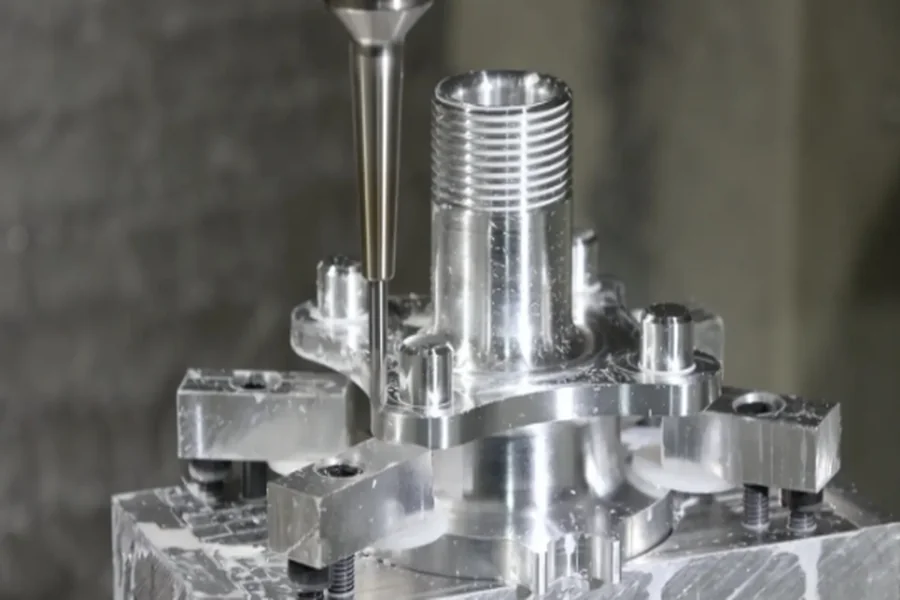
Product development is more often done in several different places today. The engineering teams may design the component in one country, source the materials in another country, and need the components in yet another country. This distributed workflow is enabled by multi-axis CNC machining, enabling the creation of complex parts with controlled accuracy, repeatability, and efficient tool access. With digital quoting and international manufacturing, companies can go from CAD to parts without having to oversee the entire manufacturing process. It is appropriate for prototypes, special parts, and scaling production for various industries.
1. Multi-Axis Machining for Complex Part Geometry
Complex components may include angled faces, deep features, curved profiles, and details that are spread across multiple faces. Many of these features can be achieved through conventional 3-axis machining but may require multiple setups if multiple surfaces need to be precisely aligned.
Multi-axis machining eliminates this workflow by providing the ability to move the cutting tool and workpiece along other axes. Four-axis and 5 Axis CNC machines can access features from various angles and minimise reorientation.
This is especially useful when the relationship between the dimensions of features is important. Reducing the number of setups can minimize opportunities for alignment errors and enable manufacturers to machine complicated geometries more efficiently.
2. Why Global Sourcing Benefits Precision Manufacturing
International CNC sourcing opens up more manufacturing capacity, material options, machining capabilities, and production knowledge for engineering teams. It can also offer tangible solutions in the absence of multi-axis special equipment in local facilities.
A global supplier can produce components from a variety of engineering metals and plastics, such as aluminium, stainless steel, titanium, brass, zinc, engineering plastics, and high-performance plastics. Thus, the selection of materials may be based on mechanical, thermal, chemical or dimensional requirements of the component.
This versatility can ease the process of procurement for businesses that have several product programs. One manufacturing partner can handle prototype levels, low-volume orders, and higher production volumes as designs evolve.
3. Digital Ordering Makes CNC Sourcing More Efficient
Engineers have been forced to adapt to the online manufacturing environment, altering the way they start a machining project. Digital workflows enable technical teams to send CAD models, drawings, material needs, quantities, and finishing details electronically, rather than depending on lengthy quotation exchanges.
These online CNC machining services can interface design information with engineering review and production planning. A professional DFM assessment can detect issues related to thin walls, deep cavities, internal radii, holes, threads, and unusually tight tolerances before the machining process has begun.
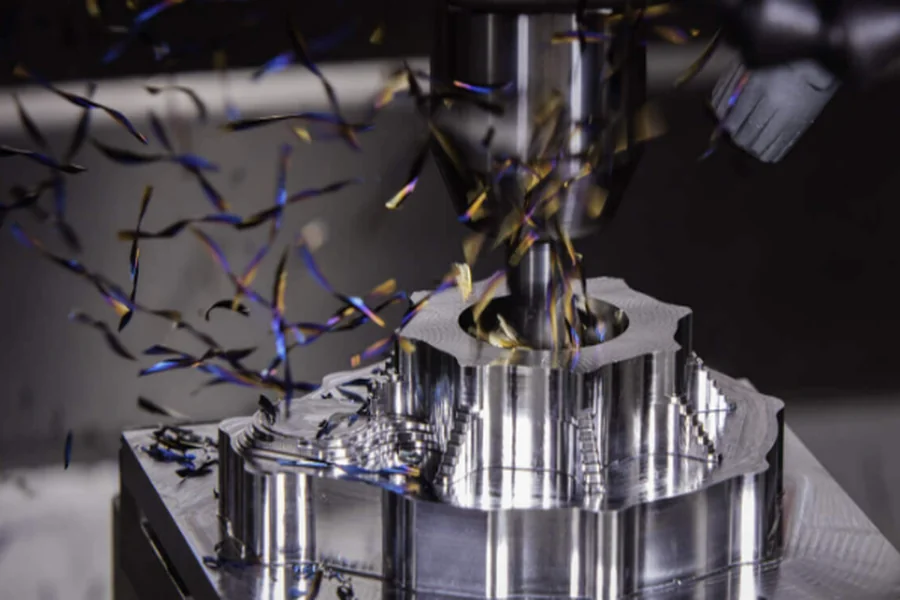
A streamlined workflow typically follows these stages:
- Upload CAD files, technical drawings, quantities, and specifications.
- Review DFM feedback and receive a manufacturing quotation.
- Approve production details before machining and inspection begin.
- Arrange international shipment after parts pass quality checks.
4. Precision Control Across Multiple Machining Processes
Multi-axis milling is just one of the various processes involved in CNC manufacturing. Machining strategies vary depending on the geometry of the components and can be combined to achieve a better final result.
CNC turning can be used for manufacturing cylindrical parts like shafts, bushings, and other rotational components. Mill-turn equipment can combine turning and milling operations, eliminating the need for separate setups to turn parts with milled features.
For conductive materials with complex shapes, wire EDM is an alternative. The process does not rely on the application of cutting forces, and therefore it is possible to obtain sharp corners, narrow slots, and complex profiles in the material if it is suitable for the process.
CNC grinding is capable of achieving a very close tolerance and surface finish for the toughest metal parts. Swiss machining is also beneficial for small diameter parts that are thin and have a single wall thickness.
5. Tolerances Depend on Design, Material, and Process
Not all features are necessarily given the same tolerance with precision machining. The actual accuracy that can be achieved is a function of the machine, material, part size and geometry, tooling, fixturing, and inspection technique.
For appropriate applications, advanced CNC machining can provide linear tolerances of up to ±0.01 mm. But if unnecessarily close tolerances are stated throughout a drawing, they can increase the machining time and cost.
A more sensible way to go is to determine critical dimensions and only set tighter requirements where function requires them. Generally, standard dimensions can be held to more liberal tolerances, and mating surfaces, bearing locations, holes, and other critical features can be held to tighter tolerances.
6. Surface Finishing Completes the Machined Component
Surface treatment can affect the performance and appearance of a component in its end use, while the geometry is determined by machining. The different finishes are dependent on the substrate and its intended use.
Popular methods include anodizing for appropriate aluminum parts, powder coating for protection and decoration, electroplating for surface characteristics, and polishing for a smoother look.
When visible tool marks are not a concern, as-machined surfaces are still a cost-effective choice. Additional aesthetic or functional characteristics can be given by sanding, bead blasting, painting, nickel plating, etc.
7. Quality Systems Support Worldwide Part Supply
Precision components across borders require manufacturing consistency. A documented quality system is useful to build repeatable inspection and production procedures from material preparation to final verification.
An ISO 9001:2015 certified manufacturer has a defined quality management system. Dimensional inspection may include coordinate measuring machines and other inspection tools, and material certifications and inspection documentation can be provided for added traceability on projects.
First article inspection and dimensional reports can offer additional confirmation for critical applications before parts are used in an assembly or production environment. The company’s 3ERP integrates multi-axis manufacturing and measuring functions and global manufacturing coordination to enable this controlled workflow.
8. From CAD File to Precision Parts Worldwide
The best international CNC production process is the one that works seamlessly between engineering, CNC, inspection, and logistics. From a single prototype to repeatable production quantities, a complete manufacturing service can accommodate changes in manufacturing processes based on the requirements of the component.
Rapid turnaround is especially important during the design validation period. Simple parts can have lead times of approximately 3 days, but if the geometry is complex, the material is special, the size is large, or the quantity is high, then there may be longer production time.
Global delivery then makes the final step to finished parts, from the manufacturing plant to the engineering teams, assembly locations, or production facilities in various parts of the world.
Conclusion
Relaxing the engineer’s constraints on local machining requirements can simplify complex manufacturing requirements through sourcing of precision multi-axis parts internationally. Intricate components with controlled dimensions and surface quality can be produced using advanced milling, turning, EDM, grinding, and Swiss machining to obtain different routes.
A digital workflow makes the process more accessible and links CAD submission, DFM review, quotation, production, inspection, and shipping. When backed by a proper choice of materials, tolerances, finishes, and documented quality control, CNC sourcing globally turns into a well-defined process from digital design to reliable physical parts.